
We are starting the year and decade with full energy!
For our March article we would like to introduce to you to the Ikigai Model. It comes from Japan and more concretely from the island Okinawa, where the most people older than 100 years live. I believe it’s not at all a coincidence that the place from where Ikigai comes is the same place where the people live the longest in the world.
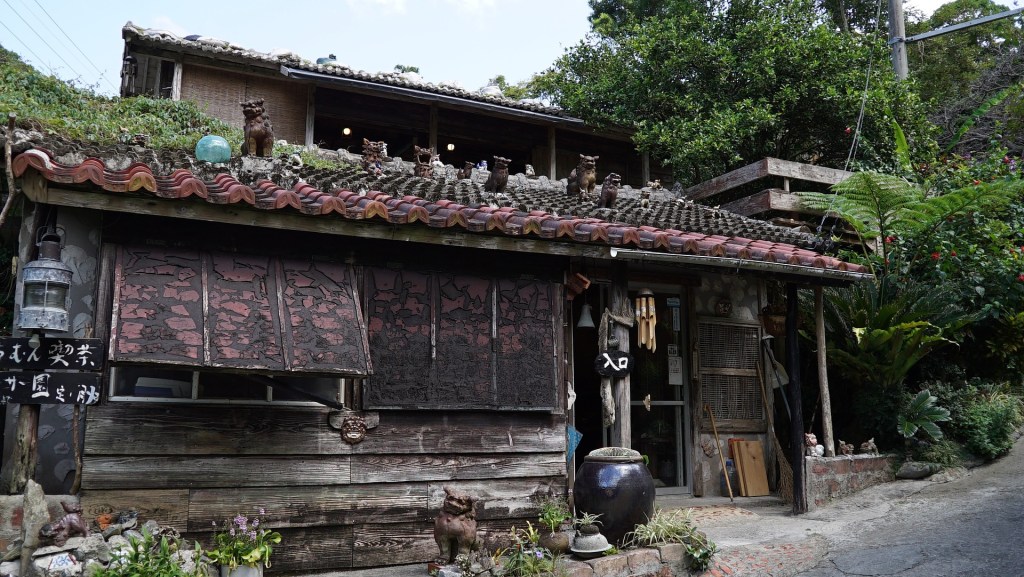
Japan is one of my favorite countries out there. The way they live their life and appreciate it, the way that they care for themselves and the nature around them, the style of their clothes and the interior design. I see a lot of things one can learn from them.
As a beginning we are going to start from the definition of “Ikigai”. The actual meaning is iki=life and gai=worth, your life’s worth, “reason for being”. It is a method through which a person can find his life’s purpose, a deeper meaning for his personal existence.
We can see from the map below how Ikigai is made. The four circles represent different ‘domains’ of your life and they are linked to each other, like everything in the world. This actually also represents the Japanese culture, which has a holistic view of wholeness between humanity and nature. Individually the circles all have a different meaning and they have several crossing points. Each of these points combines at least two of the circles and has a meaning, but whenever there are crossing points of two or three circles, something is missing. Only when they all cross, are we fully completed. The center of the four circles is the ikigai.
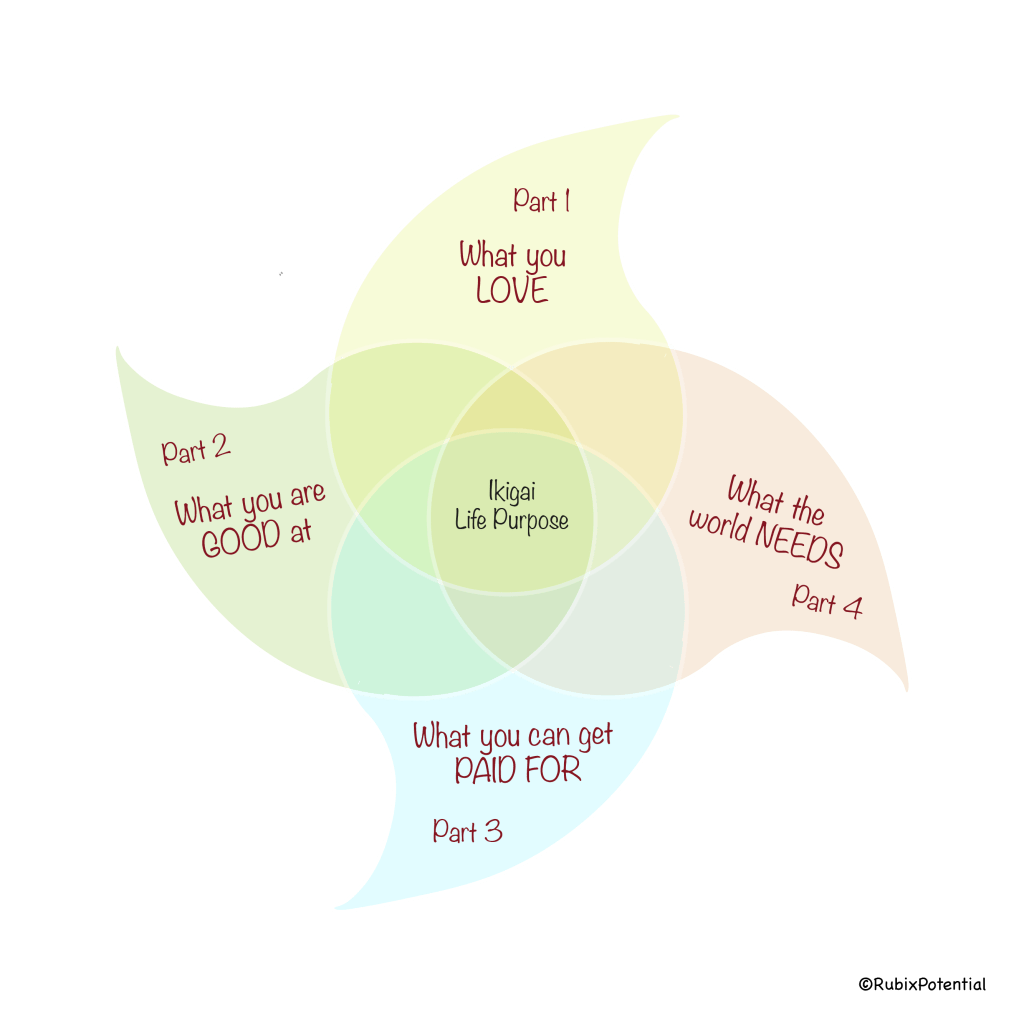
This is simply a way of navigating your thoughts, emotions, skills and experience to find the thing that bring you joy and fulfilment.
Let’s take a closer view to the circles and their crossing points. First there is the crossing between ‘what you love’ and ‘what you are good at’. I believe this is the most pleasant one because it is deeply related to each one of us. We all love to do things we are passionate about and are good at – so that crossing point is our passion. You love doing it and it gives you pleasure because it seems so easy since you are good at it.
The second crossing point is between ‘what you love’ and ‘what the world needs’. Honestly, I don’t think many of us remember that all the people in the world are connected and actually a single doing/action by a single person can create huge change. And this is why not many people consider that circle although it is a very important one – it is your mission. It is the thing that connects your heart to the world.
The third crossing is between ‘what you are good at’ and ‘what you can be paid for’. This one is easy for many people, since often the job you do is something you are good at – this is your profession.
The last crossing between two circles is the one between ‘what you can be paid for’ and ‘what the world needs’. People who know that crossing point for themselves are truly lucky because this is their vocation. Being paid for helping the world is very fulfilling.
From the picture you can see every center of three crossing circles. It is very well explained how although you might have three out of four circles managed in your life, if one is missing there will always be a part of you that will be unsatisfied. In order to be completely satisfied and get the most of life you have to understand all of the circles for yourself. To find your Ikigai.

Everybody says that when you do something you love for a living you will not work a day in your life. Well, this is the purpose of Ikigai. It’s a model which helps you find everything that makes you you, everything that makes you unique, happy and is waking you in the morning being excited to start your day and really enjoy every minute of your life.
Watching one TedTalk, I found the talker saying something very interesting: “Start with part-time Ikigai.” This is really something so small yet will have an amazing value. By doing part time Ikigai you begin to make time for yourself, focusing on how you feel, what you want to achieve, how you can be helpful. Little by little, the picture will get clearer and you will connect more and more to yourself. Sometimes we want to have the answer immediately, but we need some time as it is a process. Life is pretty overwhelming sometimes and we get caught up in the everyday life and suddenly when we have to reflect on ourselves, we find it difficult and we stop. The quick answer is it’s not all or nothing. Everything takes time and effort, but consistency is the real key to success.
Some people find their Ikigai very easy, others are found by Ikigai, but a lot of other people get lost along the way. The important thing is to develop consciousness and work on yourself. Some don’t want to find their Ikigai, they just go with the flow.
If you still haven’t found your Ikigai and you want to, the intention is the first step. Then you can start with the part time Ikigai and we would like to help you! We know it’s hard to write down things for every circle and that’s why we developed a little scheme with questions to navigate and help you. You can download the file, print it if you want, or start filling it out directly on your computer. We hope it connects you more to yourself and direct you to your personal Ikigai!

One more thing before you go!
Your Ikigai can be different in the different stages of your life. For example, your Ikigai now might not be the same 10 years from now. The most important take away is to start thinking in the Ikigai way and be connected to yourself. That model helps you get a deeper understanding of yourself and if you make a integrate it in your life, you can easily understand when you personal Ikigai changes. As the world evolves, we don’t know what the reality will be in a couple of years and therefore we don’t know what kind of opportunities there might be. For example, 20 years ago people had no idea about social media and the incredible impact it will have on people’s everyday life. So, keep that in mind, listen to yourself, evolve with the world and always find happiness and fulfilment.
By Anna
 journey of happinez